
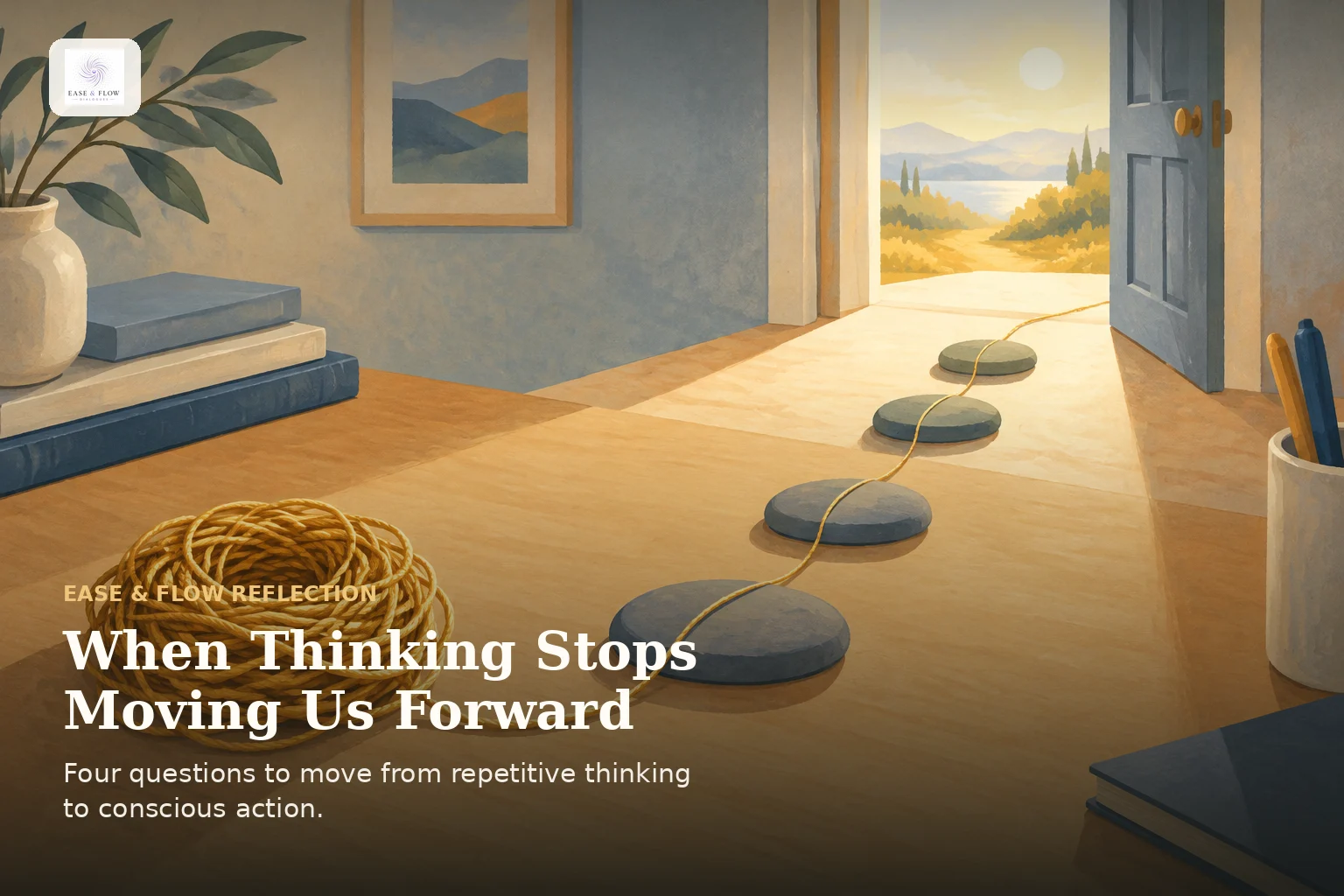

Have you ever found yourself thinking about the same situation repeatedly?
Perhaps it was a conversation that didn't go as expected. A decision you made a few months ago. An opportunity you didn't take. Or something that might happen in the future.
You revisit it while driving, during a meeting, before going to sleep, or even while doing something completely unrelated.
You think about what you could have said differently. What you should have done. What might happen next. What someone else might be thinking.
And yet, after all that thinking, you find yourself exactly where you started.
Nothing has changed. No new information has emerged. No decision has been made.
This is what I call the Unconscious Loop.
Two directions in which our minds get caught

Our minds have an interesting way of keeping us occupied. Quite often, this happens in two directions.
1. The 'If Only' loop: Replaying the past
"If only I had handled that conversation differently."
"If only I had taken that opportunity."
"If only I had made a different decision."
We revisit situations that have already happened, replay conversations and imagine alternative outcomes.
There is nothing wrong with reflecting on the past. Reflection helps us learn. The difficulty begins when reflection turns into repeated attempts to mentally change something that has already happened.
We keep revisiting the same moment, hoping that another round of thinking will somehow make it different.
2. The 'What If' loop: Rehearsing the future
"What if things don't work out?"
"What if they misunderstand me?"
"What if I make the wrong decision?"
"What if something goes wrong?"
Here, our minds are trying to prepare us for possibilities. We imagine different scenarios, anticipate reactions and attempt to find answers to questions that may never arise.
Planning and preparing are useful. But when we start treating every possibility as something that needs to be mentally resolved in advance, we can end up spending enormous energy on things we don't yet know.
And somewhere in between, we can lose touch with what is actually happening now.
When does thinking become overthinking?
Thinking is not the problem. In fact, thoughtful reflection, analysis and anticipation are essential to making good decisions.
The question is: Is our thinking creating something useful?
There are three signs that our thinking may have become a loop:
1. Repetition without discovery
We keep having the same conversation with ourselves. The thoughts may sound different, but the underlying questions remain unchanged.
2. No new information
We are not discovering anything new. We are simply rearranging the information we already have and looking at it from another angle.
3. No movement
Despite all the thinking, we are not making a decision, seeking missing information or taking an action.
Sometimes, the more we think, the more complicated the situation begins to appear.
We may mistake the amount of time spent thinking for the amount of progress made.
A small shift that can change the experience

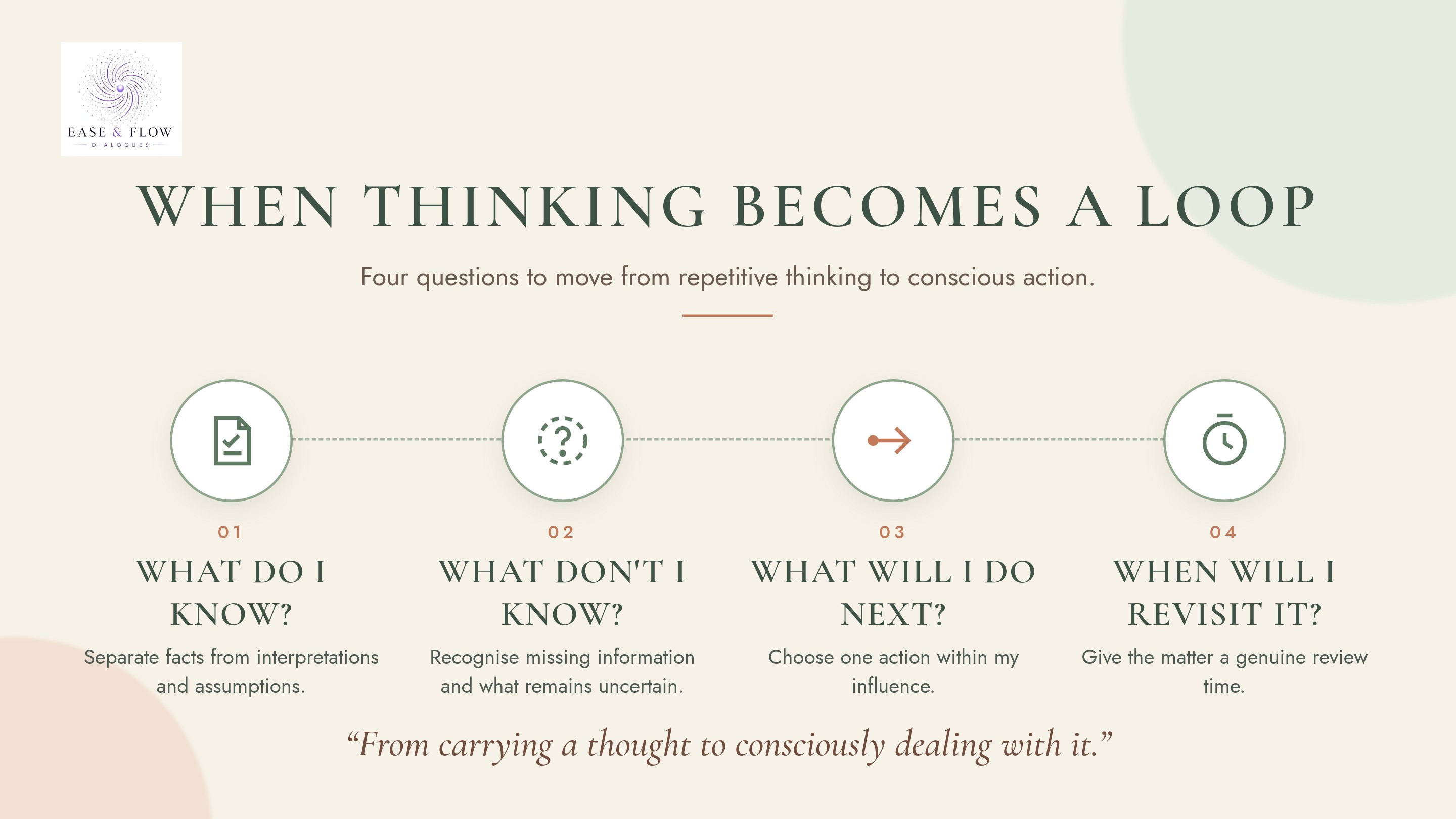
What if, instead of trying to find one more answer in our minds, we paused and asked ourselves four different questions?
Not questions that encourage us to think more, but questions that help us engage with reality.
1. What do I know?
Start with the facts.
What has actually happened? What information do I have? What do I know for certain?
Separate what you know from what you have interpreted, assumed or imagined.
For example, if someone hasn't responded to your message, the fact is that you haven't received a response. The belief that they are unhappy with you is an interpretation, not yet a fact.
2. What don't I know?
Acknowledge the unknowns.
What information is missing? What am I assuming? What am I trying to predict without having enough information?
Sometimes, recognising what we don't know is more useful than spending another hour trying to find an answer.
Not every unknown needs to be resolved immediately. Some things require a conversation, some require information, and some simply require time.
3. What will I do next?
Bring your attention back to what is within your influence.
Is there a conversation I need to have? Is there information I need to seek? Is there a decision I can make? Is there something I can do differently?
The next action doesn't have to resolve the entire situation. It only needs to create meaningful movement.
4. When will I revisit it?
This is an important question that we often overlook.
Some decisions genuinely need more time. Some situations are waiting for information. Some outcomes are not entirely within our control.
Instead of allowing these matters to occupy our minds continuously, give them a genuine review time.
For example:
"I will ask for the missing information today and revisit this decision tomorrow at noon."
This is not about avoiding the issue or pretending it doesn't matter. It is about giving the issue the attention it deserves without allowing it to occupy every available moment.
The difference between carrying a thought and dealing with it

There will always be situations that require us to think carefully.
There will be decisions that are difficult. Conversations that are uncomfortable. Outcomes that remain uncertain.
The intention is not to stop thinking, eliminate uncertainty or find an answer to everything.
It is to recognise when our thinking is no longer helping us move forward.
Sometimes, what we need is not another round of thinking. We need to acknowledge what we know, accept what we don't know, identify what we can do and consciously decide when to revisit the matter.
That small shift can create a different relationship with our thoughts.
Perhaps the next time you catch yourself saying "If only" or "What if", you could pause and ask:
Am I thinking my way towards a possibility, or am I simply going around in circles?
And perhaps that is where a little more ease and flow begins.
About Ease & Flow Dialogues™
Ease & Flow Dialogues™ helps senior professionals and business owners develop presence, perspective, resilience and conscious choices — so they can meet life and leadership as they unfold.
Explore Ease & Flow Dialogues