

Sometimes, what we see on the surface is only a fraction of what is happening within us.

A colleague asks a question, and we get irritated.
A team member misses a commitment, and we feel disappointed.
Someone offers a suggestion, and we become defensive.
A family member asks for something, and we find ourselves responding with impatience.
The interesting part is that we often know exactly why we are reacting.
Or at least, we think we do.
"They should have known better."
"I have explained this so many times."
"Why does everything have to come to me?"
"They simply don't take ownership."
Our mind is remarkably quick at making sense of what has happened. It takes an incident, attaches a meaning to it, creates a narrative and presents that narrative to us as the truth.
And before we realise it, we are no longer responding just to the incident.
But there is something even more interesting happening beneath this.
There are layers.
And we rarely take the time to see them.
One reaction. Many layers.
Consider a leader who gets visibly irritated when a team member asks for an extension on an assignment.
The immediate reaction is frustration.
The thought is simple: "Why can't this person take ownership?"
But that may only be the first layer.
Beneath that irritation could be another thought:
"I am already stretched. I have too much on my plate."
Go one layer deeper, and there may be something else.
"If this gets delayed, I will have to answer for it. I cannot afford another situation going wrong."
And beneath that, perhaps an even deeper narrative:
"I have to be on top of everything. I cannot depend on people to deliver."
Now look at what has happened.
What began as irritation with a team member has travelled through pressure, fear of failure, a need for control and perhaps an underlying belief about being responsible for everything.
The team member's request hasn't changed.
But the leader's understanding of their own reaction has.
And that changes the conversation that can follow.
The frustration may still need to be addressed. The commitment may still need to be honoured.
But there is now room to understand the other person rather than simply judge their behaviour.
The first reaction told us what we felt. The layers revealed what was happening within us.
The Five S's of Unlayering
When we begin looking beneath the surface, we start noticing that our reactions, thoughts and emotions don't exist in isolation. There are several layers that influence how we experience a situation.
I find it useful to think of these as five layers: Surface, Story, Setting, Significance and Seeing.
These are not five steps to follow mechanically. They are five dimensions of an experience that often remain invisible until we become willing to look beyond our immediate reaction.
Let's explore what each reveals.
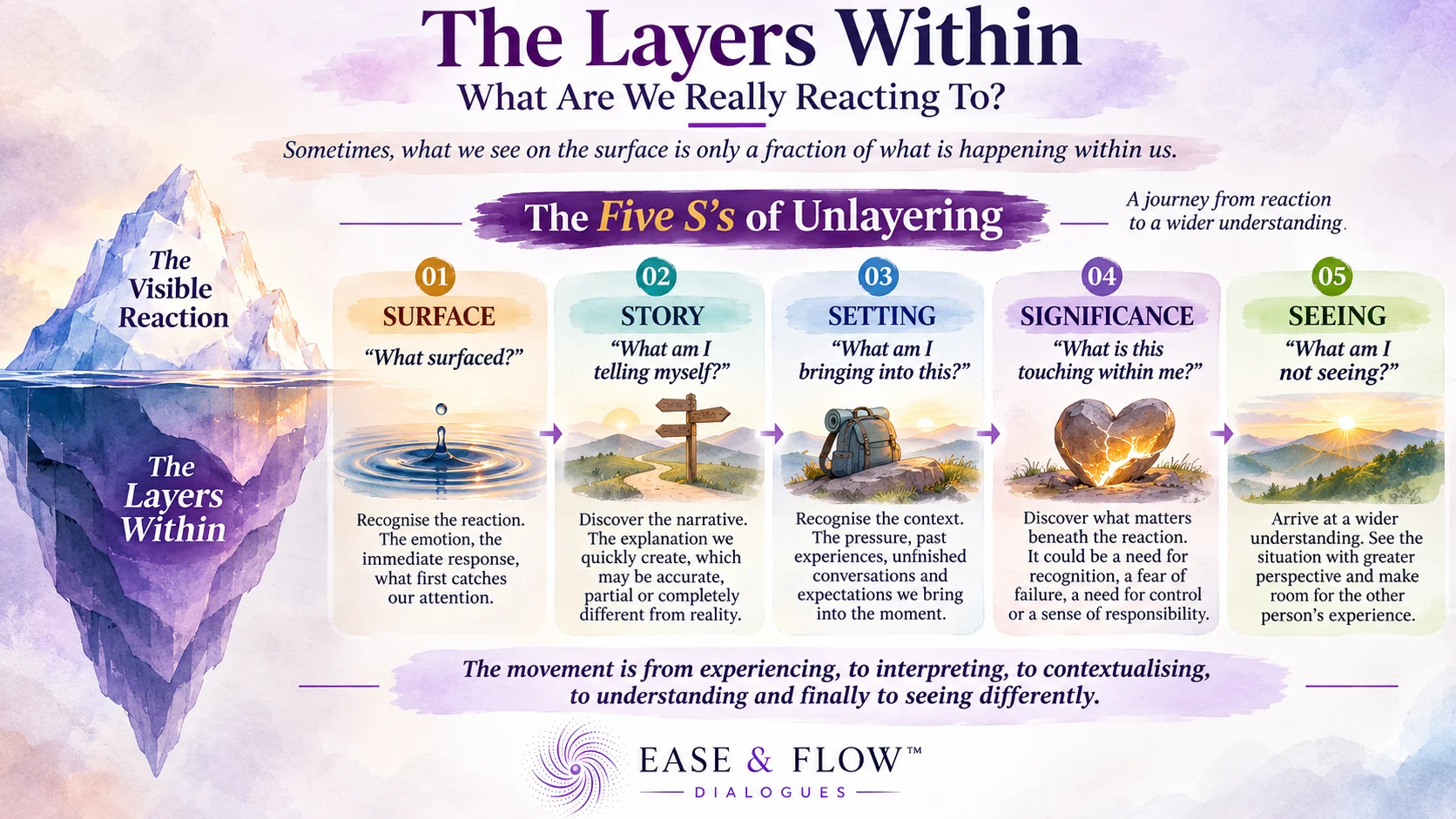
1. SURFACE What surfaced?
Something happened. You felt irritated, disappointed, defensive, anxious or uncomfortable.
This is the first visible layer. Before explaining or justifying it, simply recognise what has surfaced.
It is the emotion, the immediate reaction, the first thing that catches our attention.
2. STORY What am I telling myself?
Our mind quickly creates an explanation.
"Why can't they understand?"
"Why does this always happen to me?"
"They don't value my contribution."
This is the story we have attached to the incident. It may be accurate, partially accurate or completely different from what is actually happening.
The incident is one thing. The meaning we give it is another.
3. SETTING What am I bringing into this?
We rarely react to an incident in isolation.
We bring accumulated pressure, previous experiences, unfinished conversations, expectations and disappointments into the present moment.
Sometimes, the situation in front of us is only the last addition to something that has been building for a while.
The same request can feel perfectly reasonable on one day and incredibly irritating on another. The request may be identical, but the setting within us is different.
4. SIGNIFICANCE What is this touching within me?
Is it touching our need for recognition? Our expectation of being understood? Our fear of failure? Our need for control? Our sense of responsibility?
This is where we begin discovering why something that appears relatively small can feel so significant to us.
A disagreement may touch our need to be right.
A question may touch our insecurity about being competent.
A lack of appreciation may touch a long-standing feeling of being taken for granted.
The significance of an incident is not always determined by what happened. Sometimes, it is determined by what it touches within us.
5. SEEING What am I not seeing?
With the earlier layers becoming visible, we can now see the situation with greater perspective.
We can distinguish what happened from what we assumed. We can recognise our own experience while making room for the other person's experience.
The situation may not have changed. But our understanding of it has.
We become less hurried in our conclusions, less certain about our assumptions and more available to understand what is actually happening.
The movement is from experiencing, to interpreting, to contextualising, to understanding and finally to seeing differently.
These five layers are not a formula for analysing every interaction. They are a way of recognising that there is often more to an experience than what first meets the eye.
We don't just experience emotions. We interpret them.

One of the fascinating things about the human mind is how quickly it moves from an experience to an explanation.
Someone doesn't respond to our message.
The first thought might be that they are ignoring us.
That thought creates irritation.
The irritation reinforces the belief that we are being disregarded.
Soon, we have a complete narrative about the person's attitude, priorities and intentions.
Yet, the only thing that actually happened was that they didn't respond to a message.
Everything else was interpretation.
This is how our internal narratives take shape.
A small incident touches an existing expectation. The expectation creates a thought. The thought gives the emotion a particular meaning. And that meaning influences how we respond.
Sometimes, the emotion is not even about the incident itself.
It is about something the incident reminds us of.
A disagreement may touch our need to be recognised.
A question may touch our insecurity about being competent.
A request may touch our accumulated exhaustion.
A lack of appreciation may touch a long-standing feeling of being taken for granted.
And because these experiences are not always visible to us, we attribute the entire reaction to what just happened.
That distinction can change a lot.
The labels we put on others have layers too.

This becomes even more interesting when we begin observing how quickly we interpret other people's behaviour.
We call someone resistant.
We say someone lacks ownership.
We describe someone as overconfident, insecure, difficult or indecisive.
We often make these assessments based on what we see and experience.
But what if the behaviour we are observing is only the visible layer?
What we describe as resistance could be uncertainty about what is expected.
What we call a lack of ownership could be a fear of making the wrong decision.
What appears to be arrogance could be an attempt to protect a fragile sense of competence.
What looks like disengagement could be disappointment that has been building for months.
What appears to be indecisiveness could be someone struggling with competing expectations.
Of course, not every behaviour has a hidden explanation that changes our assessment of it. Accountability still matters. Performance still matters. Boundaries still matter.
But there is a difference between holding someone accountable and assuming we understand everything about their behaviour.
The former requires clarity.
The latter often requires nothing more than an opinion.
And opinions, once formed, can become surprisingly difficult to dislodge.
Sometimes, the label we give someone becomes the very thing that stops us from seeing them.
The invisible weight we bring into every interaction

Perhaps one of the biggest reasons we struggle to see beyond the surface is that we rarely enter an interaction without carrying something from elsewhere.
An unfinished task.
A difficult conversation.
An expectation that wasn't met.
A responsibility that has been weighing on us.
A disappointment we haven't acknowledged.
A concern we haven't expressed.
All of these become part of the internal landscape from which we experience the next interaction.
This is why the same request can feel perfectly reasonable on one day and incredibly irritating on another.
The request may be identical.
But the layers within us are different.
Our capacity, our expectations, our thoughts and our accumulated experiences influence the meaning we attach to what is happening.
And sometimes, we end up giving someone a reaction that has very little to do with what they actually did.
They become the recipient of emotions that have been building long before they entered the conversation.
This is perhaps one of the least visible ways in which we complicate our relationships.
We bring yesterday's disappointments into today's conversations and then wonder why a simple interaction becomes difficult.
There is more beneath the surface than we realise

Unlayering is not about analysing every thought or finding a hidden reason behind every emotion.
It is about recognising that our immediate understanding of an experience may be incomplete.
It is about developing enough presence to distinguish between what happened, what we thought about it, what we felt, and the meaning we eventually attached to it.
And this applies far beyond our reactions.
A person may say they want a promotion. But beneath that aspiration could be a desire for recognition, a need for security or a longing to prove something to themselves.
A leader may say they want a high-performing team. But beneath that promise could be a desire to stop carrying the entire organisation on their shoulders.
A coach may hear a client say they are stuck. But beneath that statement could be a conflict between what the client wants and what they are afraid of losing.
The stated problem, the visible emotion and the actual experience are not always the same thing.
There are layers to our ambitions, our resistance, our disappointments, our expectations and even our promises.
And the ability to see those layers gives us access to a much richer understanding of ourselves and the people around us.
Perhaps the real opportunity is to see beyond the obvious

We spend a considerable part of our lives responding to what is immediately visible.
The words someone says.
The decision someone makes.
The commitment someone misses.
The expectation that isn't met.
The emotion that surfaces.
But the visible experience is often only the beginning of a much larger story.
The more present we become, the more we begin to notice the distinction between an incident and our interpretation of it, between a person's behaviour and our assumptions about it, between the emotion we experience and the deeper experience that may be driving it.
And somewhere in that distinction, something changes.
We become less hurried in our conclusions.
Less certain about our assumptions.
More curious about what is actually happening.
More capable of articulating what we are experiencing.
And more available to the person in front of us.
Not every layer needs to be uncovered. Not every reaction needs an explanation. Not every situation requires us to look for something deeper.
But when we do take the time to see beyond the obvious, we often discover that the story is very different from the one we initially believed.
Perhaps that is one of the most important aspects of becoming present.
There are layers within all of us.
And sometimes, the greatest clarity comes not from finding more answers, but from seeing what was already there, beneath the surface.
About Ease & Flow Dialogues™
Ease & Flow Dialogues™ helps senior professionals and business owners develop presence, perspective, resilience and conscious choices — so they can meet life and leadership as they unfold.
Explore Ease & Flow Dialogues