
I have a question for you.
Imagine I offered you the best motorcycle in the world. You could choose any motorcycle you have ever dreamt of owning. A Harley-Davidson, a Ducati, a Triumph, or perhaps something even more extraordinary.
There is just one condition.
In exchange for that motorcycle, all you have to give me is your balance.
Would you accept the offer?
Think about it for a moment.
You could own the most expensive motorcycle, experience the thrill of riding it, travel wherever you want and enjoy everything that comes with owning something extraordinary.
But if you cannot maintain your balance, what would that motorcycle be worth?
In fact, what would almost anything in your life be worth if you had to give up your ability to maintain your balance?
This little thought experiment got me thinking about something we spend a considerable part of our lives chasing.
Balance.
We talk about work-life balance, financial balance, emotional balance, balancing our relationships, balancing our ambitions, balancing our health and even balancing our thoughts.
It almost seems that balance is the ultimate destination we are all trying to reach.
But what if we have got the entire conversation about balance wrong?
The never-ending chase

Look around us.
Someone is trying to balance their professional and personal life.
Someone else is trying to balance their financial ambitions with the desire to spend more time with family.
Another person is trying to balance their health, appearance and lifestyle.
A leader is trying to balance the expectations of the organisation with the expectations of the people working for them.
A parent is trying to balance their children's needs with their own aspirations.
And somewhere in all this, an individual is trying to balance their own expectations with the reality of their life.
We have almost normalised the idea that life is an exercise in balancing things.
But I wonder where this chase begins.
Does it begin because our lives are genuinely out of balance?
Or does it begin because we have accepted a particular idea of what a balanced life should look like?
Think about it.
We see someone who leaves work at 5 PM and spends their evenings with family. We think that person has achieved work-life balance.
We see someone who earns well, exercises regularly and takes holidays. We think that person has achieved balance.
We see someone who appears calm, composed and unhurried. We assume that person has found their inner balance.
But are we looking at their reality or our interpretation of their reality?
And more importantly, are we measuring our lives against an image of balance that may not even be relevant to us?
Perhaps the problem is not that we lack balance.
Perhaps the problem is that we have created an expectation of what balance must look like.
The illusion of a perfectly balanced life

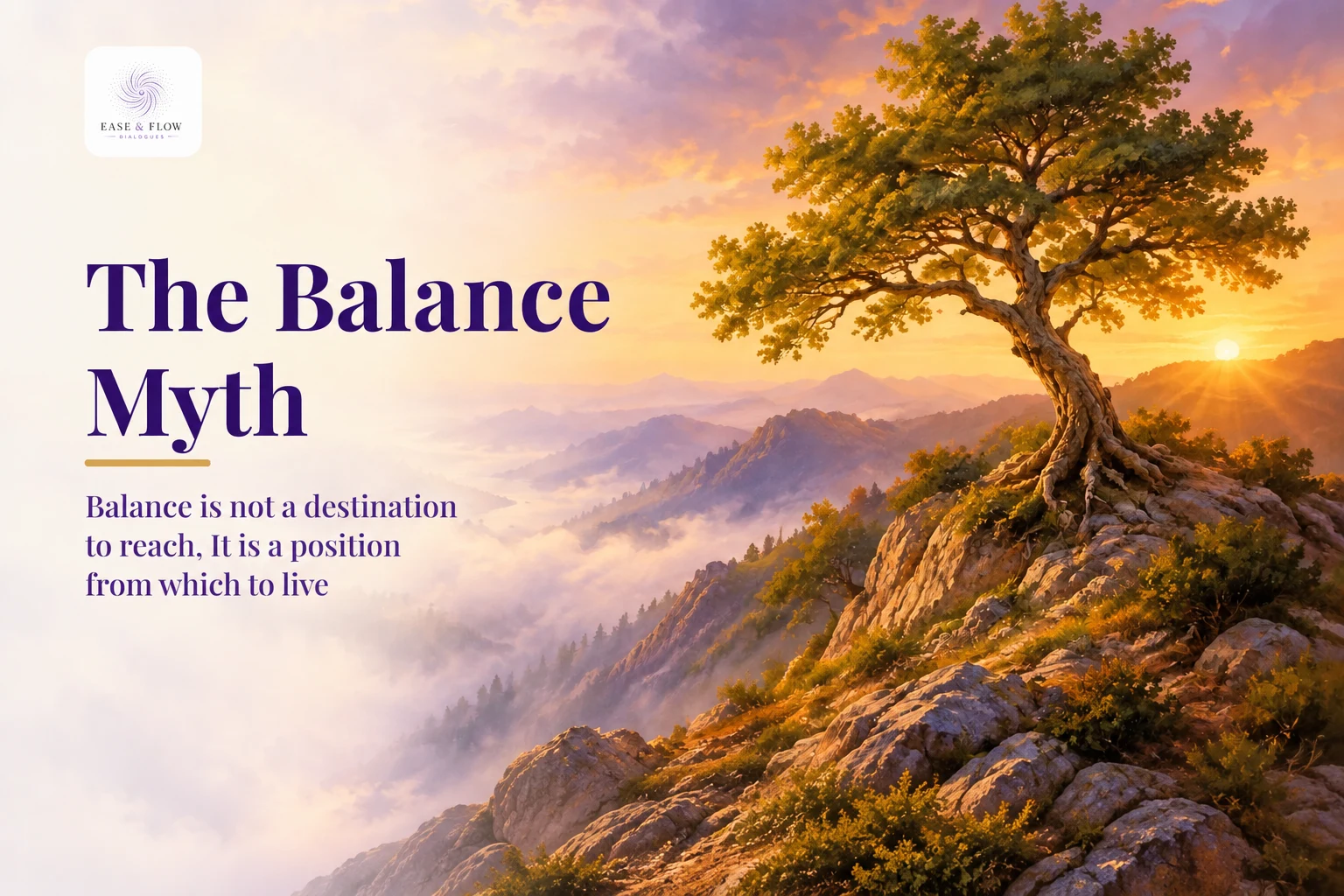
Let us look at nature.
Have you ever noticed how a mountain landscape looks?
There are mountains of different heights, valleys, plateaus, rivers, rocks and uneven terrain.
Nothing looks identical.
The river does not flow in a perfectly straight line. The ocean is not always calm. Trees grow in different directions. Some branches are longer than others. Some seasons bring abundance, while others bring stillness.
Yet we do not look at nature and conclude that something is wrong because everything is not equal.
We do not expect every mountain to have the same height.
We do not expect every river to flow at the same speed.
We do not expect every tree to grow in the same direction.
We appreciate nature because of its diversity, movement and ability to adapt.
There is a beautiful lesson here.
Nature does not demonstrate balance through perfect symmetry. It demonstrates it through dynamic relationships, continuous adjustment and coexistence.
Perhaps human life is not very different.
There will be periods when your professional life demands more attention.
There will be periods when your family needs you more.
There will be moments when your health deserves priority.
There will be times when your ambitions take centre stage.
And there will be periods when you simply need to slow down and pay attention to yourself.
Does that mean your life is out of balance every time your attention shifts?
Or is that simply life responding to what the moment requires?
The cost of believing that we are always out of balance

I believe there is a hidden cost to constantly chasing balance.
The moment we believe that our current situation is an imbalance, we create a sense of inadequacy.
We start looking at what is missing.
We start comparing.
We start feeling guilty about the time we spend at work, the time we do not spend with family, the money we have not earned, the fitness goals we have not achieved or the relationships we have not nurtured.
Even when we are doing reasonably well, we begin questioning whether we are doing enough.
And this creates a rather interesting paradox.
We are physically present at dinner but mentally occupied with work.
We are at work but feeling guilty about not being at home.
We are spending time with our family but thinking about the opportunities we might be missing professionally.
We take a holiday but spend half the time worrying about what is happening back at the office.
We achieve something we have worked towards for years, but almost immediately start thinking about what comes next.
We are rarely where we are.
We are either thinking about where we should have been or worrying about where we need to get to.
And perhaps this is where the real imbalance begins.
Not necessarily in the distribution of our time, money or responsibilities, but in our inability to be present with the reality of the moment.
What if balance is not about equal distribution?
Consider this.
Does a good leader spend exactly the same amount of time with every team member?
Does a good parent give every child exactly the same attention at every moment?
Does a successful entrepreneur distribute their energy equally across every business activity?
Does a healthy individual eat exactly the same quantity of every food group at every meal?
Of course not.
Balance is contextual.
Sometimes one thing needs more attention than another.
Sometimes you need to push harder. Sometimes you need to step back.
Sometimes you need to speak up. Sometimes you need to listen.
Sometimes you need to pursue an opportunity. Sometimes you need to let it go.
The ability to recognise what the situation requires and respond consciously is perhaps far more important than trying to distribute everything equally.
Balance, therefore, may not be about equal distribution.
It may be about conscious allocation.
And that requires something we often overlook: the ability to remain connected with ourselves while responding to what is happening around us.
The balance that begins within

Let me offer another perspective.
Imagine you are standing on uneven ground.
There are stones beneath your feet. The surface is not flat. There may be a slope. The wind may be blowing.
You cannot change the terrain immediately.
But you can adjust your posture.
You can become aware of where your feet are placed.
You can recognise the direction in which you might lose your footing.
You can make a conscious adjustment.
You do not need the ground to become perfectly flat before you can stand.
And you certainly do not need to blame yourself for the unevenness of the ground.
This is how I have started looking at balance.
It is not about making everything around us perfect.
Think about a difficult day at work.
You have had a disagreement with a colleague. A deadline has been missed. Your manager is unhappy. There are several expectations waiting for you.
You could immediately react, become defensive, blame someone or carry the frustration into your evening.
Or you could pause.
Acknowledge that the situation is difficult.
Understand what is within your control.
Recognise what needs your attention.
And decide what you want to do next.
The circumstances may remain exactly the same for the moment.
But your relationship with those circumstances has changed.
You are no longer allowing the situation to determine your entire state of being.
You have found your footing.
And perhaps that is a far more meaningful definition of balance.
The ROOT Framework: Finding your balance without chasing it
If balance is not a destination, how do we practise it?
I would like to offer a simple four-step approach.
Think of the roots of a tree.
A tree does not stand tall because every branch is equal or because every leaf is positioned perfectly.
It stands because it is grounded.
Even when the weather changes, the branches move, the leaves fall and the seasons shift, its roots provide stability.
We can learn something from this.
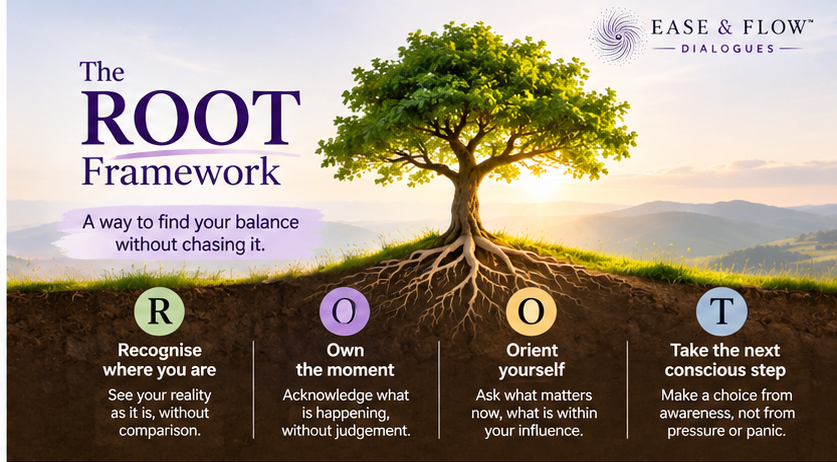
R – Recognise where you are
The first step is to recognise your present reality.
Not where you think you should be.
Not where someone else is.
Not where you imagined you would be five years ago.
Where are you right now?
Perhaps you are doing well professionally but struggling to find time for yourself.
Perhaps your finances are uncertain but your relationships are strong.
Perhaps you are achieving your goals but feeling exhausted.
Perhaps you are enjoying a relatively peaceful phase of life.
Whatever it is, recognise it.
The moment you stop comparing your reality with an imagined ideal, you create the possibility of responding to what is actually happening.
You cannot find your footing if you refuse to acknowledge where you are standing.
O – Own the moment
The second step is to own the moment.
This is not about taking responsibility for everything that happens to you.
It is about acknowledging your present circumstances without immediately labelling them as good, bad, right or wrong.
If you are overwhelmed, acknowledge that you are overwhelmed.
If you are disappointed, acknowledge the disappointment.
If you are happy, allow yourself to experience that happiness.
If you are uncertain, accept that uncertainty exists.
We often spend so much energy resisting what is happening that we have very little energy left to understand what needs to happen next.
Owning the moment does not mean accepting every circumstance permanently.
It means giving yourself permission to see the situation clearly before responding to it.
O – Orient yourself
Now comes an important question.
Given where I am and what is happening, what matters most right now?
Not everything deserves equal attention.
Not every expectation needs to be fulfilled immediately.
Not every problem needs to be solved today.
Not every opportunity needs to be pursued.
Orienting yourself means identifying what deserves your attention in the present moment.
Ask yourself:
What is important here?
What is within my influence?
What needs my attention now?
What can wait?
What might I be doing out of guilt, fear or the need to please someone?
This step helps you distinguish between what is demanding your attention and what genuinely deserves it.
T – Take the next conscious step
The final step is to take action.
Not necessarily a dramatic action.
Not an attempt to fix your entire life.
Just the next conscious step.
It could be having a difficult conversation.
It could be saying no.
It could be asking for help.
It could be taking a break.
It could be giving your family undivided attention.
It could be making a decision you have been postponing.
Or it could simply be recognising that nothing needs to change immediately.
The important thing is that your next step emerges from awareness rather than an automatic reaction.
You are no longer moving simply because you feel pressured to do something.
You are moving because you have consciously chosen what matters.
That is the ROOT approach.
Balance does not mean standing still

There is one more misconception worth addressing.
Sometimes, when we talk about inner balance, we imagine a person who is always calm, composed and unaffected by circumstances.
But that is not what I am suggesting.
You can be ambitious and balanced.
You can be uncomfortable and balanced.
You can be disappointed and balanced.
You can be pursuing a challenging goal and balanced.
You can be going through a difficult phase of life and still have moments of balance.
Balance does not require the absence of emotions, ambition, challenges or change.
It requires the ability to remain connected with yourself while experiencing them.
A person who is balanced is not necessarily someone who never loses their footing.
It is someone who recognises when they have lost it and develops the ability to find it again.
There is no expectation of perfection here.
There is an invitation to awareness.
And that makes balance a practice rather than an achievement.
What if we stopped chasing balance?
Imagine what might change if we stopped treating our lives as projects that constantly needed correction.
What if we stopped feeling guilty every time one area of our lives demanded more attention?
What if we stopped comparing our circumstances with someone else's definition of a balanced life?
What if we stopped believing that we must first get everything in order before we can feel at peace?
Would we become less ambitious?
I don't think so.
Would we stop working towards better health, stronger relationships, financial independence or professional excellence?
Certainly not.
In fact, we might become more effective at pursuing all of these.
Because when we stop fighting our present reality, we can use our energy to make conscious choices about our future.
We can pursue change without rejecting ourselves.
We can have ambitions without constantly feeling inadequate.
We can acknowledge difficult circumstances without allowing them to define us.
We can accept that life is uneven without concluding that life is unfair.
And perhaps, most importantly, we can stop postponing our peace until everything around us falls into place.
Perhaps the balance was never missing

I want to return to the motorcycle I offered you at the beginning.
Would you exchange your balance for the best motorcycle in the world?
I suspect most of us would say no.
Because somewhere within us, we understand that the ability to stand, move, adjust and experience life is far more valuable than the things we accumulate along the way.
Yet, in our everyday lives, we often behave as though we need to sacrifice that very ability to acquire the things we want.
We sacrifice our peace for professional success.
We sacrifice our health for financial security.
We sacrifice our relationships for recognition.
We sacrifice the present for a future that we hope will eventually be better.
And then we spend our remaining energy trying to restore the balance we believe we have lost.
Maybe it is time to reconsider this entire approach.
What if the way life is, is simply the way life is?
Uneven. Changing. Unpredictable. Sometimes exciting, sometimes difficult, sometimes rewarding and sometimes uncomfortable.
There will be mountains and valleys.
There will be sunshine and rain.
There will be moments of certainty and moments of confusion.
We cannot expect life to become a perfectly laid-out road before we begin walking.
But we can learn to walk with awareness.
We can learn to stand where we are.
We can learn to acknowledge what is.
We can learn to decide what matters.
And we can learn to take our next step consciously.
Perhaps balance is not something we need to find. Perhaps it is something we need to stop losing sight of.
A thought to leave you with
The next time you catch yourself saying, "My life is out of balance," pause for a moment.
Ask yourself:
Am I actually out of balance, or am I comparing my present reality with an expectation of how life should look?
And if I stopped chasing the perfect version of balance, what would I choose to do differently today?
Because life does not have to be perfectly balanced for you to experience it fully.
You just need to find your footing.
At Ease & Flow Dialogues™, our endeavour is to help individuals and leaders move from pressure to presence, from unconscious reactions to conscious choices, and from constantly chasing an ideal life to experiencing greater ease and flow in the life they are already living.
Perhaps the journey towards ease and flow begins with something as simple as this:
Stand where you are. Find your footing. And then choose your next step.
About Ease & Flow Dialogues™
Ease & Flow Dialogues™ helps senior professionals and business owners develop presence, perspective, resilience and conscious choices — so they can meet life and leadership as they unfold.
Explore Ease & Flow Dialogues