

Two people who have known each other for twenty years may spend the next ten avoiding a conversation that could fundamentally change their relationship. Neither necessarily wants the relationship to deteriorate. Both may even value it enough to believe that raising a sensitive subject would do more harm than good.
What is curious about this arrangement is that both individuals are making decisions about the relationship based on an assumption that the relationship itself has never been given an opportunity to test.
They may eventually conclude that certain things cannot be discussed between them. Yet this conclusion rests less on the experience of having those conversations than on years of not having them.
There is something particularly interesting about avoidance in this respect. While its immediate purpose may be to protect us from an uncomfortable experience, its longer-term consequence can be to protect our assumptions from being challenged.
The experiences we never have

In 2009, psychologist Peter Lovibond and his colleagues published an experiment in Behaviour Research and Therapy examining the relationship between avoidance and the persistence of fear.
Participants were conditioned to associate certain visual stimuli with an unpleasant electric shock. They were also taught that pressing a button could prevent the shock. During a subsequent phase, the researchers stopped administering the shock in response to a particular stimulus. Some participants, however, retained the option of pressing the protective button.
The results were revealing. Those who experienced the stimulus without being able to press the button gradually learned that it no longer predicted a shock. Those who continued using the protective response largely retained their expectation of danger.
For the latter group, the absence of an unpleasant outcome did not provide sufficient evidence that the situation had become safe. Their own protective behaviour could account for its absence.
The experiment was conducted under controlled laboratory conditions, and everyday human relationships are considerably more complex. Nevertheless, it illustrates a dilemma with implications well beyond the study of anxiety.
Consider someone who had an unpleasant experience expressing disagreement early in their career. They may subsequently become extremely careful about challenging authority. Years later, working in an entirely different organisation with a different leadership team, they continue exercising the same caution.
Their professional life may proceed without significant conflict, reinforcing their belief that withholding disagreement is a sensible strategy. What remains unknown is how their career might have developed had they been more willing to express an independent point of view.
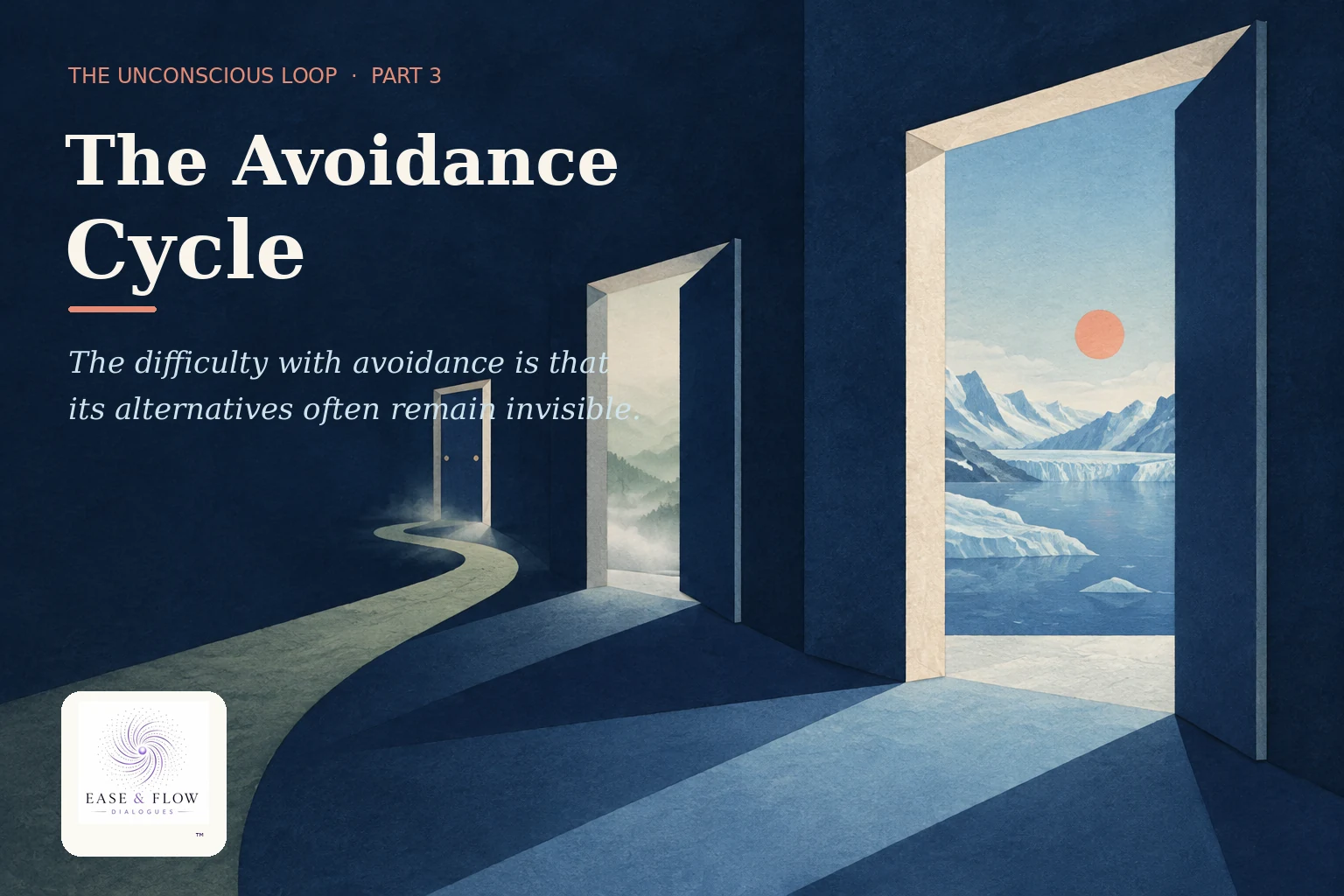
The difficulty with avoidance is that its alternatives often remain invisible.
We rarely know the outcome of the conversation we never initiated, the opportunity we never explored or the relationship we never allowed to develop. Yet we may become increasingly certain about what would have happened.
The productivity of avoidance

Avoidance is commonly associated with inactivity, although some of its more sophisticated expressions involve considerable effort.
An entrepreneur who is uncomfortable approaching prospective customers may spend weeks refining a business proposal. A leader reluctant to make a difficult decision may commission additional analyses. A professional dissatisfied with their career may continue acquiring qualifications without seriously exploring an alternative.
Each of these activities has legitimate value. What makes them interesting is that they can simultaneously serve as productive endeavours and as alternatives to something the person finds emotionally demanding.
In their 2013 paper, Procrastination and the Priority of Short-Term Mood Regulation, psychologists Fuschia Sirois and Timothy Pychyl examined procrastination as a problem of emotional regulation rather than simply one of time management. Their argument was that people frequently defer unpleasant tasks in favour of activities that improve their immediate emotional state, leaving the consequences to be experienced by their future selves.
This also offers a connection to the behaviour explored in The Proving Trap. An individual may devote extraordinary energy to demonstrating competence in an area where they already feel capable, partly because another area of life requires them to encounter uncertainty.
Professional accomplishment, for instance, may offer a reassuring alternative to addressing difficulties within a personal relationship. The accomplishment is real, and the effort involved may be considerable. Neither necessarily reveals what else the individual is moving away from.
There are limitations, therefore, to evaluating progress through activity alone. A person can become exceptionally accomplished at something while making remarkably little movement in an area that matters deeply to them.
When silence becomes agreement

The consequences acquire another dimension when avoidance becomes a shared behaviour.
In 1993, psychologists Deborah Prentice and Dale Miller published a series of four studies examining attitudes towards alcohol consumption among university students. They found that students generally believed their peers were more comfortable with campus drinking practices than they themselves were.
Many were privately uncomfortable with a social norm they believed others accepted. In one of the studies, male students' attitudes subsequently shifted towards what they mistakenly understood to be the prevailing norm.
The researchers examined this phenomenon through the concept of pluralistic ignorance: a situation in which people's perceptions of collective opinion differ from what individuals privately believe.
There are striking parallels in organisational life.
Members of a leadership team may have reservations about a strategic direction, yet each interprets the absence of objections from colleagues as evidence of collective support. An individual who considers raising a concern may decide against it, believing that others are comfortable with the decision.
In their 2000 paper on organisational silence, published in the Academy of Management Review, Elizabeth Morrison and Frances Milliken explored how workplace conditions can create a collective belief that speaking openly is unwise, and how this can restrict an organisation's capacity for change and development.
For leaders, this presents a particularly difficult problem. Traditional measures of alignment may reveal very little about what remains unexpressed. Meetings can run smoothly, decisions can receive unanimous approval, and interpersonal relationships can appear cordial, even while considerable disagreement exists beneath the surface.
Nor is it necessary for anyone to be deliberately dishonest. People may genuinely believe they are preserving relationships, respecting authority or protecting the organisation from unnecessary conflict.
The eventual culture becomes something that few individuals consciously intended to create but that many participate in sustaining.
The gradual narrowing of possibilities

Perhaps the most consequential effects of avoidance are not found in the problems we leave unresolved, but in the possibilities we cease to consider.
A person who repeatedly avoids unfamiliar social situations may eventually describe themselves as someone who does not enjoy meeting new people. Someone who has not explored professional opportunities outside their existing domain may become convinced that their capabilities are restricted to that domain.
These conclusions may, of course, be accurate. Human beings have genuine preferences, limitations and interests. But there is also a possibility that what appears to be self-knowledge has been shaped by a progressively restricted range of experiences.
Over the years, a preference for familiarity can become difficult to distinguish from a preference for the familiar thing itself.
This is where avoidance becomes an unconscious loop. An anticipated experience creates discomfort; moving away from it brings relief; and the relief makes the response more likely to recur. At the same time, the person loses an opportunity to acquire information that might have altered their original perception.
The loop influences both behaviour and belief.
Eventually, the decision to avoid a particular experience may no longer feel like a decision. It becomes incorporated into an understanding of one's personality: I am not good at confrontation. I am not entrepreneurial. I am uncomfortable with change.
What began as a response to a particular experience can become a statement about who we are.
The intelligence of stepping away

There would be little merit in treating avoidance as inherently undesirable. The ability to anticipate danger and distance ourselves from it is an essential feature of human survival and judgement.
An employee who chooses not to challenge an abusive superior may be making a realistic assessment of organisational power. A person who withdraws from a destructive relationship may be exercising sound judgement. Deferring a conversation while emotions settle can create conditions for a more constructive exchange.
Indeed, a 2018 experimental study by Sophie van Uijen and colleagues adds an important qualification to the research on protective behaviour. It found that behaviours which prevented people from encountering evidence against an anticipated threat interfered with fear reduction. Protective behaviours that merely reduced a threat, without preventing such learning, did not necessarily have the same effect.
Protection and exploration, in other words, need not always be incompatible.
This distinction matters because an indiscriminate insistence on confronting discomfort can become another form of psychological pressure. Human beings do not owe every situation their engagement, every relationship their continued investment or every opportunity their participation.
From the perspective of Ease & Flow, the significance of avoidance lies in the extent to which our responses remain available for conscious reconsideration. A decision that once served us well need not become a permanent instruction governing how we respond to life.
The limits of what we know about ourselves

We tend to regard experience as something that accumulates with age. Yet the breadth of that experience depends, in part, on what we have permitted ourselves to encounter.
Two people can spend thirty years in the same profession and emerge with considerably different understandings of their capabilities. One may have explored unfamiliar responsibilities, questioned established practices and allowed others to challenge their judgement. The other may have spent much of that time perfecting an already successful way of operating.
Both possess thirty years of experience. What differs is the range of evidence upon which their understanding of themselves rests.
The same may be true of relationships, ambitions and our perception of the world around us. Some of our most enduring convictions may have developed not through repeated encounters with reality, but through repeatedly declining the encounters that could have revised them.
We are accustomed to thinking that the things we have experienced shape the people we become.
It is worth considering how much of who we believe ourselves to be has been shaped by the experiences we have never allowed ourselves to have.
About Ease & Flow Dialogues™
Ease & Flow Dialogues™ helps senior professionals and business owners develop presence, perspective, resilience and conscious choices — so they can meet life and leadership as they unfold.
Explore Ease & Flow Dialogues