
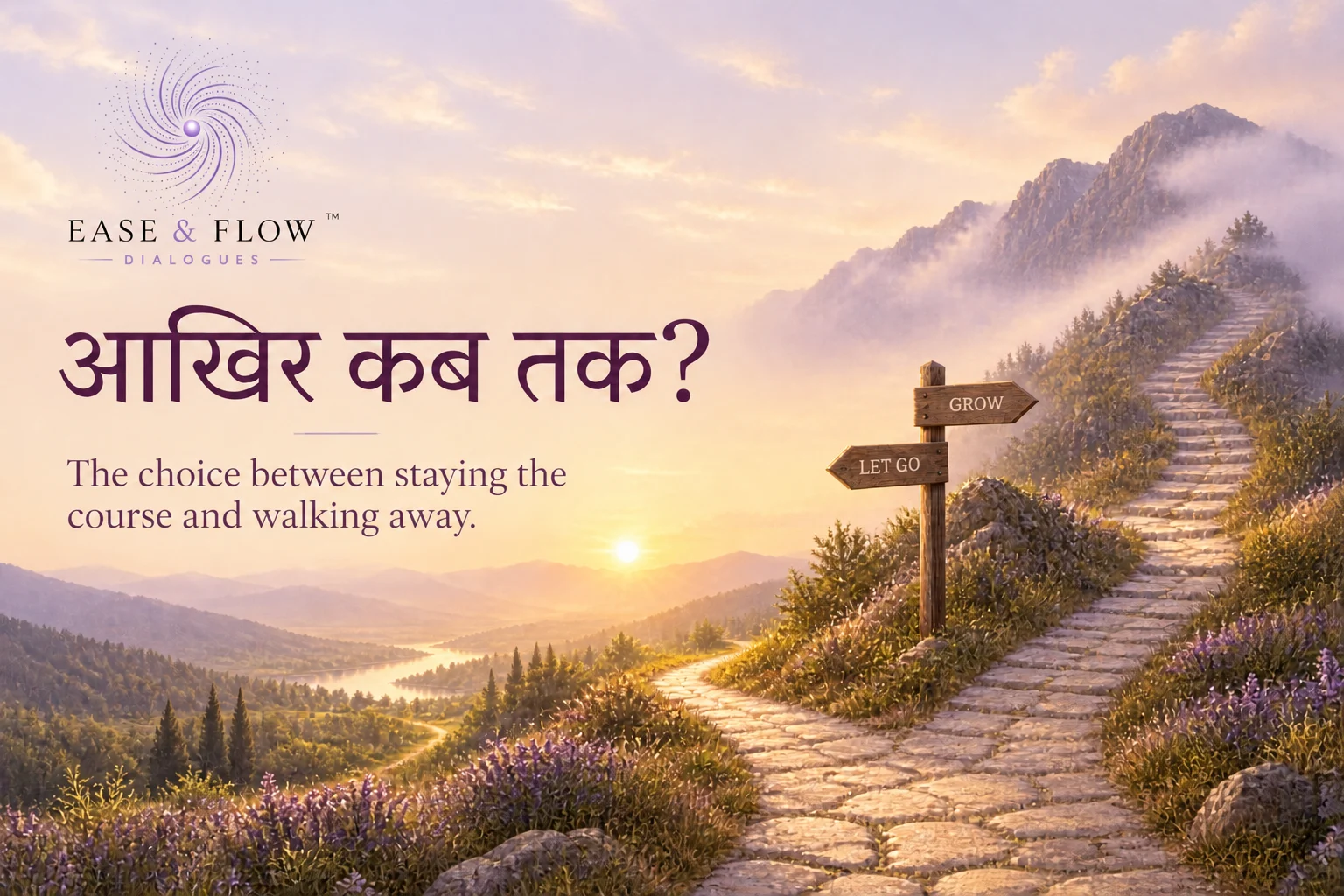

There is a certain exhaustion embedded in the Hindi expression आखिर कब तक? — how much longer?
It is rarely a question about time. A person who has spent years building a business, waiting for a career breakthrough or attempting to repair a relationship is not necessarily looking for a date on the calendar. Beneath the question often lies a more difficult one: is what I am pursuing still worth what it is asking of me?
We live in a curious culture when it comes to persistence. We celebrate the entrepreneur who refused to give up, the athlete who overcame repeated defeats and the artist who endured years of rejection before finding recognition. Their eventual success transforms their earlier struggles into inspirational stories.
Yet, somewhere alongside them are people who demonstrated comparable courage, commitment and persistence but never experienced the breakthrough. Their stories rarely make it to our bookshelves, cinema screens or conference stages.
The difference in their outcomes does not necessarily establish a difference in the quality of their commitment.
Perhaps we have allowed success to become the retrospective justification for persistence. When someone succeeds, we call it conviction. When someone fails, we may call the very same behaviour stubbornness.
But the person living through that uncertainty has no access to the ending.
The nature of the game

A filmmaker can bring together exceptional talent, invest enormous resources and produce a film that finds no audience. A business that once dominated its industry can become irrelevant. An athlete can dedicate twenty years to a sport without ever standing on a podium.
There is no contractual arrangement between effort and outcome.
This is not an argument against commitment. It is an acknowledgement of the nature of the game. Effort, preparation, creativity and persistence can influence possibilities, but they cannot eliminate uncertainty.
Interestingly, when we voluntarily enter a game, we are reasonably accepting of this uncertainty. We know that we might win or lose. Yet, when the game concerns our own ambitions, relationships or identity, we gradually begin to experience the uncertainty as something that should not exist.
We want our commitment to be rewarded, our intentions to be reciprocated and our efforts to produce evidence that we were right to make them.
It is perhaps at this point that the pursuit begins to acquire the weight of pressure.
When a choice becomes an obligation

Consider someone who started a business because they wanted to create something meaningful. Over time, the original aspiration may become entangled with the need to recover investments, justify decisions, demonstrate success to others or avoid the embarrassment of returning to employment.
The business may still be the same. The reasons for pursuing it may no longer be.
Something similar can happen in a relationship. What began as a genuine desire for companionship and connection can gradually become a determination to make the relationship work simply because walking away would mean confronting an uncomfortable reality.
The distinction is subtle but significant. We may be doing everything we were doing before, with apparently the same commitment, while operating from an entirely different place within ourselves.
The pressure may not arise solely from the absence of results. It may also arise from the meaning we have begun to attach to that absence.
What would it say about me if this did not work?
Sometimes, that question acquires greater importance than the original purpose itself.
The freedom to choose again

One of the less acknowledged privileges of being human is that we are not permanently bound to the choices we once made.
The person who chose a particular career at twenty-five is entitled to reconsider it at forty-five. Someone who once aspired to build a large organisation may discover that a smaller enterprise offers a more meaningful life. A person who has invested years in a relationship may recognise that continuing is no longer healthy or mutually desired.
Priorities evolve. Circumstances change. So do we.
Equally, the absence of results need not invalidate a purpose that continues to matter deeply. Someone may be fully aware of the uncertainty, the sacrifices and the possibility of failure, and still choose to continue. There is dignity in that choice, just as there is dignity in choosing a different direction.
Perhaps what deserves examination is whether the purpose remains relevant, whether the cost remains acceptable and whether we are still choosing the pursuit rather than feeling imprisoned by it.
And sometimes, remaining true to a purpose may require abandoning the very path through which we originally intended to fulfil it.
It is still your game

When the question आखिर कब तक? arises, perhaps it is worth returning to the person who originally decided to step onto the court.
What was it that mattered then? Does it still matter today? And where is the pressure to continue — or to give up — really coming from?
There may be no universal answer. Two people facing remarkably similar circumstances may make entirely different choices, both consistent with what matters in their respective lives.
You may choose to stay on the court without knowing whether you will win. You may choose to leave without having to declare that everything you invested was a mistake.
After all, it was never merely about winning the game.
It was about something that made the game worth playing.
And that is yours to decide, even today.
About Ease & Flow Dialogues™
Ease & Flow Dialogues™ helps senior professionals and business owners develop presence, perspective, resilience and conscious choices — so they can meet life and leadership as they unfold.
Explore Ease & Flow Dialogues